In a world that is moving faster and faster, the ability to make accurate decisions instantly is becoming a superpower. Whether you manage a company, play sports, or simply try to handle the chaos of everyday life, you need a system. A system that was born in the air, during a fight for fractions of a second.
John Boyd: The man who was ahead of his time Link to heading
The history of the OODA loop begins with John Boyd, a US Air Force colonel known as “40-second Boyd”. This nickname was not accidental – Boyd could defeat any opponent in simulated air combat in less than 40 seconds. If an opponent was “on his tail”, Boyd would reverse the situation and gain the upper hand in less than a minute.
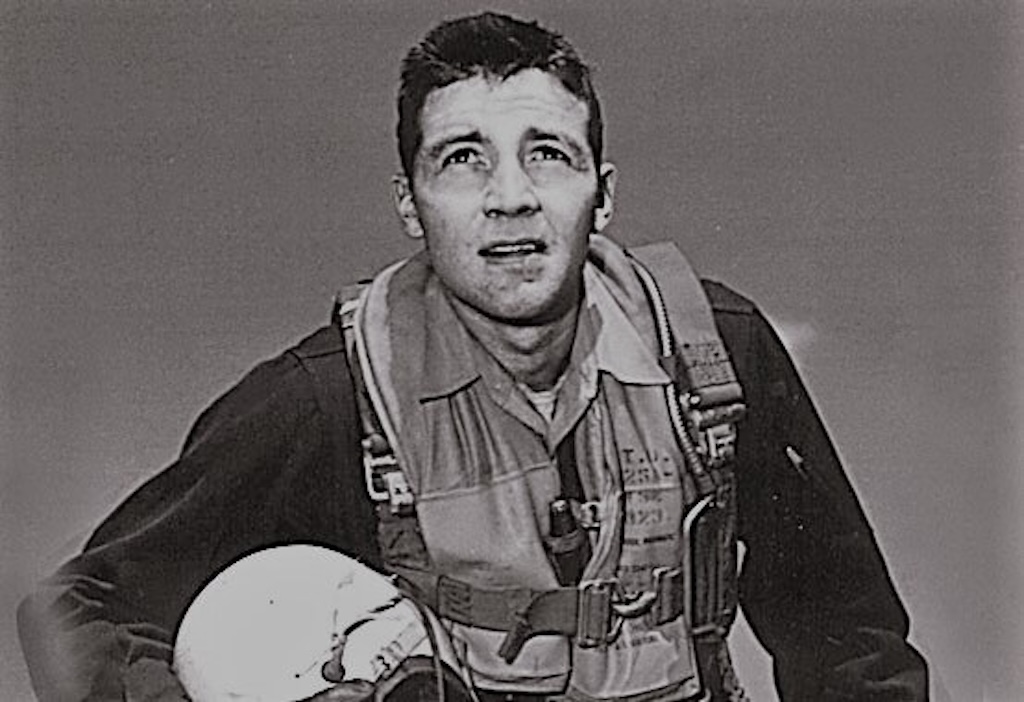
Boyd did not rely solely on instinct. As a brilliant strategist and engineer, he began to analyze why certain pilots win even though they fly machines with inferior technical parameters. He discovered that the key is not the speed of the aircraft, but the speed of the decision-making cycle. This insight led to a strategy that revolutionized US war doctrine (e.g., during Operation Desert Storm) and is still taught in military schools around the world today.
What is the OODA Loop? Link to heading
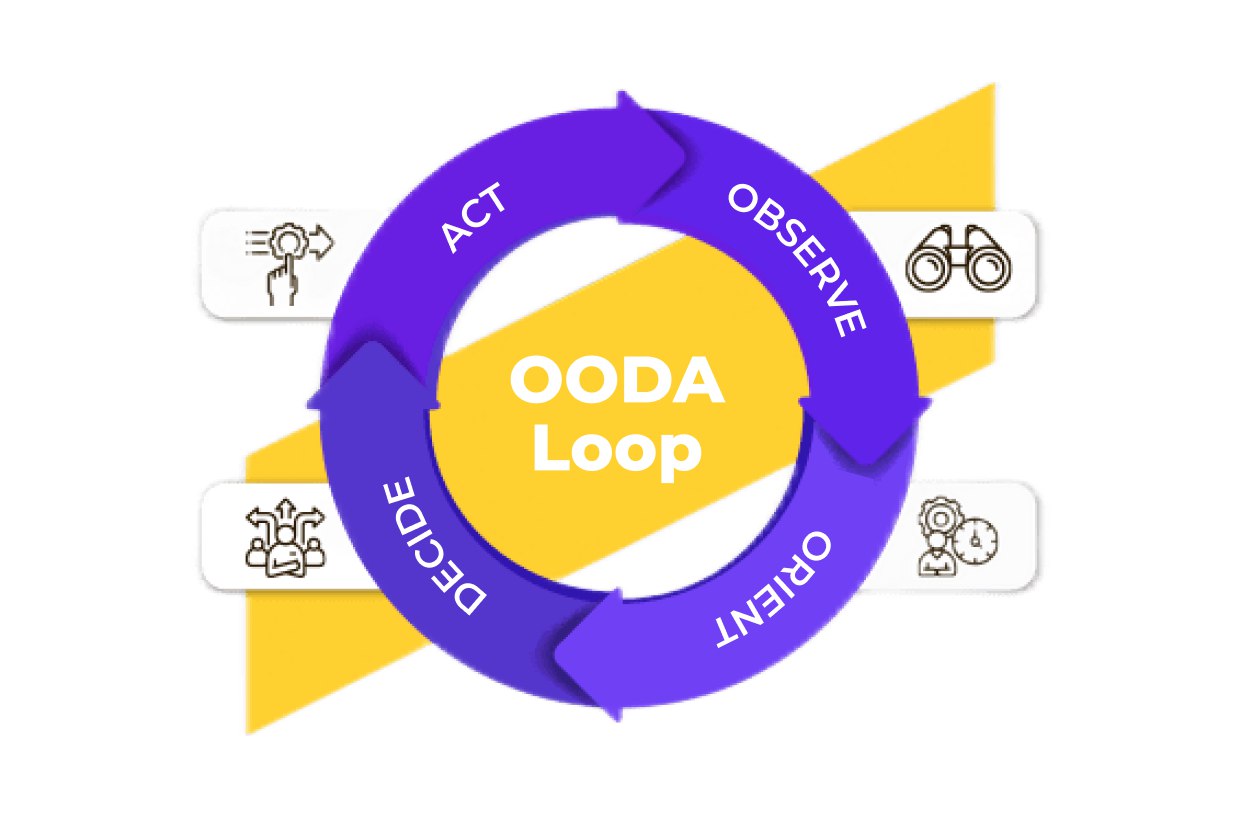
OODA is an acronym for four stages: Observe, Orient, Decide, and Act. Although it sounds simple, the devil is in the details and the continuity of this process.
- Observe: Gathering raw data from the environment. What is happening? What are the facts? What signals are reaching you from the market, from loved ones, or from your own body? It is important not to filter this data through the prism of expectations.
- Orient: This is the most important and difficult stage. It consists of giving meaning to the collected information. Here, your experience, culture, genetics, and prior knowledge create a model of reality. Orientation allows you to see patterns where others see chaos.
- Decide: Choosing a specific plan of action based on the created model. This is the moment of transition from theory to practice.
- Act: Implementing the decision into life. At this stage, you only focus on acting on the decision you have already made.
The key word is loop. After performing an action, you immediately return to observation to see how the world reacted to your move. With each subsequent turn of the loop, you will see more and more, be better aware of the situation, make better decisions and act more effectively - because it is only one turn of the loop. It will be better in the next one. The goal is to implement such a loop permanently in everyday life.
The OODA Loop in everyday life Link to heading
How can you use a fighter ace’s strategy while sitting at your desk or planning your day?
- Increase your “operational speed”: In stressful situations, we are often paralyzed by analysis (so-called analysis paralysis). The OODA loop teaches that a fast, imperfect decision followed by a correction is better than no decision while waiting for the ideal.
- Update your mental models: The biggest mistake is getting “stuck” at the orientation stage—believing in an outdated picture of the world. Regularly challenge your assumptions. Is what you knew about your industry a year ago still true?
- Shorten the “Observe” phase with a signal checklist: Instead of collecting everything, keep a fixed set of 5–7 signals (e.g., deadline, risk, cost of error, energy/fatigue, dependencies, who makes the decision). This speeds up the start of the loop.
- Do “Orient” out loud or on paper (30–90 seconds): One sentence: “Most likely X is happening because of Y; if I’m wrong, I’ll see Z.” Orientation becomes testable rather than vague.
- Treat decisions as hypotheses, not verdicts: Choose actions that let you gather feedback quickly (a small experiment) instead of jumping straight into a “life project.”
- Set the “next smallest step” (NSS): If you’re stuck, the decision is: what is the smallest move that will push this forward by 1%? OODA likes micro-moves.
- Close the loop with a short “After Action Review”: After a meeting/task, ask 3 questions — What did I plan? What happened? What do I change in the next turn? Two minutes, and it builds an advantage.
- Introduce a time budget for orientation: For example, 10 minutes for analysis, then a decision. If that’s too little, it’s a signal that you’re missing data in “Observe,” not that you should think longer.
- Practice mode switching: “Decide” without new data: In the decision phase, no adding new assumptions. This removes the hidden slide back into orientation (the most common form of self-sabotage).
- Design actions for correction: Choose moves that are easy to undo or change direction. This reduces fear of deciding and speeds up action.
- Manage “information noise” like an opponent: Turn off notifications for one full turn of the loop. Too many stimuli tear apart “Observation” and destroy “Orientation.”
- Use “orientation checkpoints” in your calendar: 2–3 short check-ins per day (e.g., 11:30 and 16:30): what has changed since the morning? This is practical orientation hygiene.
- In conflicts, ask questions that reset orientation: “What is the most important fact right now?” “How will we know we’re going in the right direction?” You force the conversation from opinions back to data.
- Treat your body’s state as “Observe” data: Sleep, hunger, tension—this isn’t “weakness,” it’s information about your decision capacity. Sometimes the best “Act” is a 10-minute walk to restore the quality of the loop.
- In deep work, run OODA in mini-cycles (25–45 min): Goal → quick orientation → decide one thing → act → brief review. This turns the day into a series of controlled wins.
Summary Link to heading
The OODA loop is not just a military curiosity. It is a philosophy of life in a dynamic world. It teaches us that the winner is not the one with the most resources, but the one who can learn the fastest from changing reality and turn that learning into action. The next time you feel overwhelmed by a flood of events, take a deep breath and ask yourself: what stage of the loop am I in?