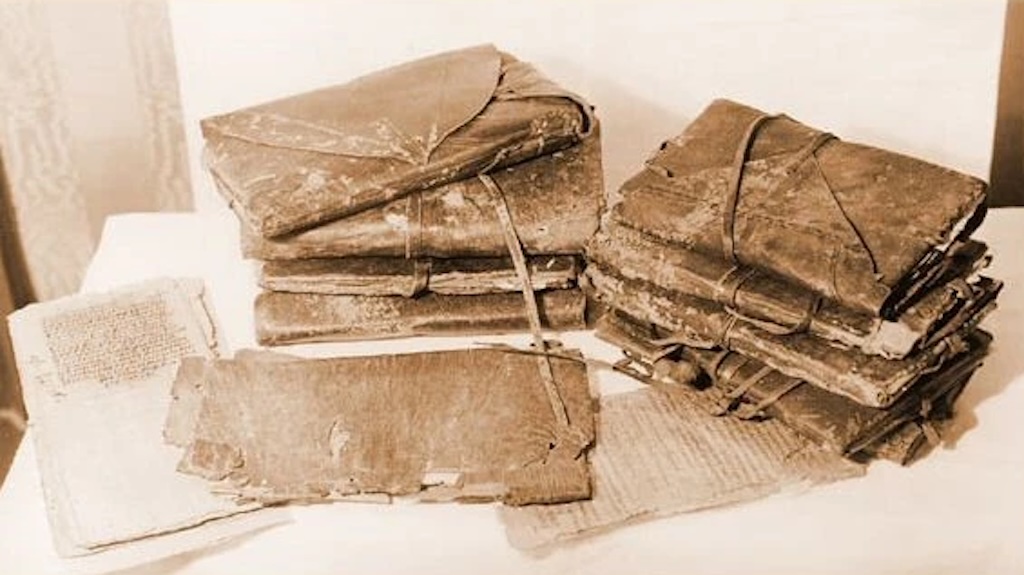
Codex VII from Nag Hammadi is one of the 13 ancient codices (manuscripts in book form) found in December 1945 in the Jabal al-Tarif mountains near the village of Nag Hammadi in Upper Egypt. It is part of the so-called Nag Hammadi Gnostic library – it probably belonged to a community of Christian Gnostics (most often identified as Valentinians or Sethians) and was hidden at the end of the 4th century when Emperor Theodosius I (380–395) began to persecute and destroy non-orthodox texts.
This is not an “ordinary” apocalypse with visions of the end of the world. It is a text that shows what really happens at the moment of the greatest drama – the crucifixion – and who in this drama really suffers, and who laughs.
Brief Context Link to heading
Peter (one of the disciples) receives a vision / revelation from Jesus even before the crucifixion. Jesus takes him “in spirit” to the place of the crucifixion and shows him what is really happening there.
The Most Important Images and Their Meaning Link to heading
Two levels of crucifixion – body and spirit
Peter sees two figures on the cross:- one is being beaten, suffering, screaming, dying (this is the psychic body, the “substitute body,” the fleshly garment that the demiurge gave to the spark)
- the other stands nearby, alive, calm, smiling, untouched (this is the true Jesus – the spark, an aeon from the Pleroma, pure consciousness)
Gnostic Meaning:
The true spark / your true self never suffers.
Only the garment that the Archons put on you suffers – the body, emotions, thoughts, the sense of “I am this body.”
The true “I” stands nearby and watches – untouched, free, smiling.The Laughter of Jesus
Jesus (the living, true figure) laughs at what the Archons and the crowd are doing.
He laughs loudly, robustly, without anger – he simply laughs at the absurdity of the situation:
“They think they are killing me, and I am not even in this body.
They think they have power, and they have no power at all.”Meaning for You:
When you finally see that suffering, fear, pressure, “I have to get something done” – it all happens only to the garment, and not to your true self – the same laughter will appear.
Not a malicious laugh, but a laugh of “oh shit… it really was an illusion.”“He who has ears, let him hear” – key words of Jesus
Jesus says to Peter:
“Some have eyes, but they do not see.
They have ears, but they do not hear.
But you have ears to hear – and eyes to see.”Meaning:
Not everyone is able to see the truth at this moment.
The hylic (person of the body) sees only the body on the cross and is terrified.
The psychic (person of the soul) sees suffering and wants to save / sympathize.
Only the pneumatic (person of the spark) sees that the true Jesus stands nearby and laughs.If you are already beginning to see this laughter – it is a sign that the spark within you has awakened.
The Overlords and their “false light”
Jesus shows Peter that the Overlords (Archons) created false religions, false sacrifices, false crosses – all so that people would believe that suffering and sacrifice are necessary.
A true sacrifice is never needed – because the true being cannot suffer.Meaning:
Everything in the material world that seems like “holy suffering,” “sacrifice for others,” “fighting for the truth” – these are often the traps of the Overlords. True freedom does not require suffering – it only requires seeing that the suffering was never yours.
The Most Important Message Link to heading
The Apocalypse of Peter tells you one simple thing:
You are not that which suffers.
The garment that the Archons put on you suffers.
The true you stands nearby – untouched, free, smiling.
When you finally see this truly (not as a theory, but in the body, in the heart, in everyday life) – the same laughter that Jesus had on the cross will appear. Not a laugh of contempt – a laugh of relief and disbelief: “For so many years I thought it was I who was dying… and I wasn’t even in this body.”
And then freedom truly begins.